
Why Most Businesses Get Keyword Intent Wrong
Most businesses rank keywords first and ask what searchers actually want second—if they ask at all. You’ll find a high-volume term, slot it into whatever content you were already planning, and hope Google notices. The result: content that matches the keyword but misses the search entirely.
“One huge thing businesses almost always do when they see a keyword is NOT think about the intent for the keyword; instead they just add the keyword to what they were planning to write, rather than stepping back and asking ‘what is this user trying to ask in this keyword’”
— Abhishek Iyer, founder of ACME.BOT
Good keyword intent analysis flips this. It helps you classify your searcher’s goal before you write a word. According to Semrush’s 2024 ranking analysis, text relevance — or how closely your content answers search intent — is the top-ranking factor on Google. Content that answers the wrong question isn’t saved by any technical SEO fix.
This is how four intent types help you get it right:
The Four Intent Types (and What Each One Signals)
Search intent can be categorized into four buckets—navigational, commercial, informational, and transactional. Each triggers different types of content on a Google results page. This can be a helpful framework to consider when conducting keyword research and planning content.
| Types of Intent | What the searcher wants | SERP signals to detect intent |
|---|---|---|
| Informational | Find out more aboutsomething | How-tos, guides, and snippets |
| Navigational | Navigate to a brand or website | Direct URLs, brand names |
| Commercial | Research buyer options | Comparisons, reviews, and buying guides |
| Transactional | Take an action on a site (booking, signing up, buying) | Shopping ads, product pages, checkout flows |
For example, a user looking for “how to fix a leaky faucet” is likely interested in the fix rather than only a product listing.
Navigational: The searcher knows exactly where they’re going. (For instance, “Netflix login” is a navigational query — they’re typing it into Google instead of going to the Netflix website directly.)
Commercial: They’re researching and weighing their options. (For example, a search for “Best project management tools” means that they’re not ready to buy yet — they’re in comparison mode. We’ll see many review and comparison-style pages ranking for this phrase.)
Transactional: They’ve decided. Keywords like “buy,” “price,” and “deal” mean they just need the checkout page.
Per Moz, these four categories make up the backbone of the SEO framework. In some industries, you might add local or visit in person as a fifth type. But these four form the foundation—and, as a result, you’ll see that they’re reflected in how Google ranks search results for queries.

How to Identify Intent: A Practical Three-Step Process
Query modifiers provide some quick insights—”how/what/why” are informational, “best/vs/review” are commercial, and “buy/price/deal” are transactional. You can also infer that signal when you look at the live SERP, as the page types in ranking positions 1–10 and SERP features, such as featured snippets, shopping ads, or local pack will show more on how Google classified the query. Many keyword research tools have this replicated at scale.
1. Read the Modifier
Identifying the meaning of modifiers like “how” or “what” indicate informational intent. Modifiers like “best” or “vs,” suggest commercial intent. Words like “buy” and “price” signify transactional.
2. Inspect the Live SERP
Google it and check the top 10 rankings. Product pages hint at the intent being transactional, whereas blog posts might indicate informational. The search results provide Google’s take on what the query means.
3. Read SERP Features
What’s featured on the SERP can also tell you a lot about the search intent behind the term. For example, if you see People Also Ask boxes or featured snippets, it likely means the query is informational. If you see shopping ads, it likely means the query has transactional intent. And if you see local packs, you likely know that the query has local intent. Google provides us its clearest signals of intent here.
Running the Full Check
Look at pages from the right search query, list types of pages in the top 10, what features show, and scan the titles for angle. If you have a large query list, AI research tools can show intent classifications at scale so you don’t have to go through a manual process of auditing tons of search queries.
Beyond Bucketing: Serving the Full Intent Behind a Query
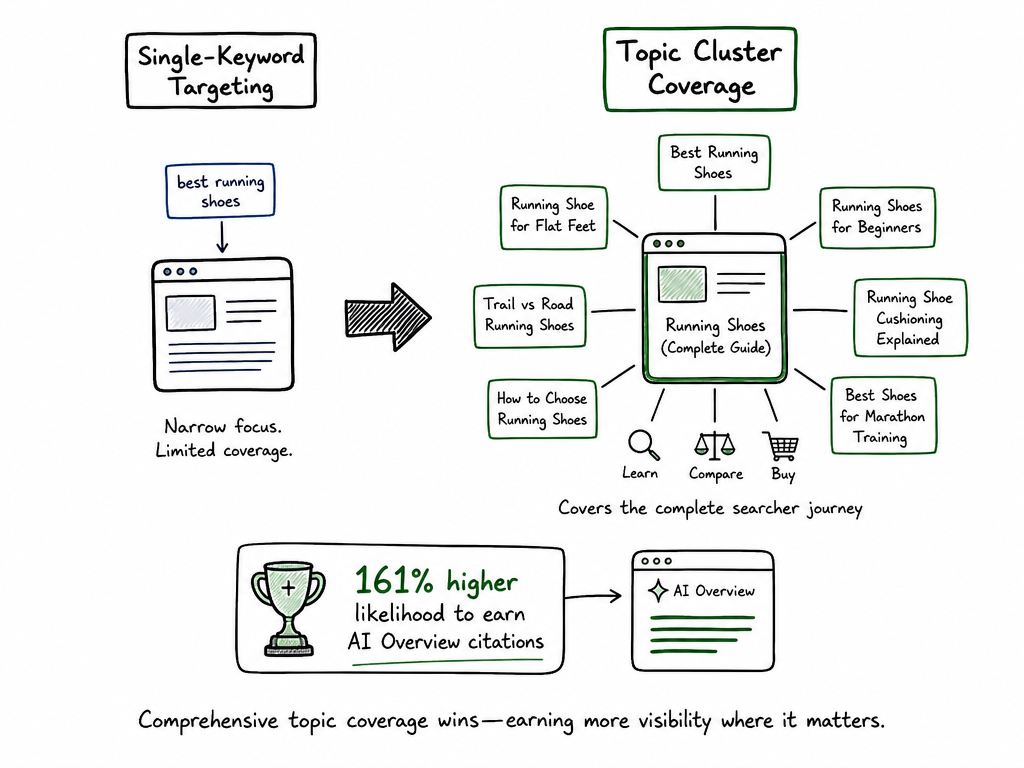
Sure, it’s good to understand that a keyword in informational. But, to actually win, you need to satisfy the full intent. For example, when someone searches for “apple pie recipe,” they aren’t just trying to find a recipe—they want to bake, buy ingredients, store the pie, and more. According to Lil Big Things, topic cluster content is 161% more likely to be recommended in AI Overviews than single keyword pages. So, it’s one thing to label keywords and another to put them to use.
“
“Keyword intent is more than only segmenting them into buckets. For example, when someone searches for
apple pie recipethey’re trying to make apple pie – so go beyond just stating the recipe and make the whole process (from the sourcing) to storing, serving etc. available”
— Abhishek Iyer, founder of ACME.BOT
The ACME.BOT team also uses a cluster approach to content strategy—identifying intent driven keywords and related subtopics that cover the full searcher journey, from initial curiosity to completion. Rather than writing one page for one keyword intent, you are building interconnected content that answers each part of what the user actually wants to do.
What really matters is that you’ve gone beyond just intent classification and into intent strategy. Covering the full task also matters once AI starts using your content to create overviews.
Keyword Intent in the Age of AI Overviews
While most AI Overview-triggering keywords are informational in nature and won’t change the volume of commercial or transactional queries, informational content plays two crucial roles: to provide guidance to humans and to provide signals to AI systems. Ahrefs reports that 99.9% of AIO-triggering keywords have informational intent. Where AIOs appear, informational CTR drops roughly 34.5%, which is where intent-matched content earns ROI by capturing the searchers who remain.
Now, you’re also writing for AI systems. They might take your work and synthesize or overview box with excerpts of it. The convergence is real.
“They’re actually converging. AI is becoming more and more like humans. So, just be to the point. Value the humans and the AI’s time. Get to the point. Take a side. Do not put pure AI content because that helps nobody.”
— Abhishek Iyer, founder of ACME.BOT
46% of searches trigger an AIO with long-tail keywords (7+ words), while most content libraries have yet to catch up. This is where you get your opening.

Putting Keyword Intent Analysis to Work
Add intent analysis to every stage of your keyword research, trend monitoring, and content planning. Match your content format with the intent type, capture the traffic that remains where AI Overviews appear, and repeat a three-step workflow (modifier → SERP → full task) that allows you to keep the task scalable across your keyword portfolios. This isn’t a task you do and forget an audit, but ongoing research.
Aligning content type with the intent of the keyword pays off. Informational keywords typically earn how-to guides or deep-dives, commercial keywords are typically content comparison pages, and transactional keywords are usually product pages or landing pages. It has proved lucrative in terms of conversions: although AIO keywords receive fewer clicks overall, the remaining clicks tend to come from buyers who are further down the funnel.
Your workflow is simple and repeatable. Start by analyzing the query modifier — those words signal intent. Confirm what you see in the live SERP. Then map the full searcher task behind the query. Do this with every target keyword and stop guessing why each page deserves to be on your content plan.