AI SEO AgentACME.BOT interviews you for your take, then writes and publishes the post around it.
7 days free, no card. Then $79/month.

Abhishek Iyer
Made by an ex-Google Search engineer.
“Running experiments on how search engines rank is my bread and butter, so when I couldn't find a tool that used AI to write genuinely helpful content, I built my own.”
as featured on


Field notes from running our blog
ACME.BOT's founder and former Google search engineer documents the workflow he uses to run the company blog with ACME.BOT.
I wrote search systems before ACME.BOT. When I thought of starting up a blog, I could just hired a content mill to write things. Instead, I chose to run it with an agent of our own -- from my phone.
Here's what's been up to this point. We're certainly still in the early days (and so far haven't seen any traffic data to showcase), and I just have a process I follow. At a minimum, every post has to clear this bar to get published: would I have enjoyed reading this?
What is an AI SEO agent?
An AI SEO agent can play the whole search game, from research to writing to publishing to refresh. It can. But should it?
We've already figured out how to build autonomous AI SEO agents - agents that can independently research, write, publish, and refresh an entire search loop. The hard part isn't building agents.
Quick answer
One characterization of an SEO AI agent is autonomous software that can run a full search loop without prompting at each step. But autonomy is the means, not the value.
Autonomy is the easy part
For almost any topic, a model can compose a syntactically correct and clean article.
Text alone is cheap. It earns no reason to be read.
Your experience, expertise, and point of view are the parts a model doesn't get to. They're not on the web and, therefore, an agent can't manufacture that. It doesn't have it.
- What the agent does. Research, drafting, illustration, scheduling, publishing: the labor.
- What stays mine. The angle, the opinion, the first-hand detail, the call on what doesn't ship.
I've seen scaled content completely tank. So our agent doesn't just write content for the sake of volume
Week 0: mapping the blog
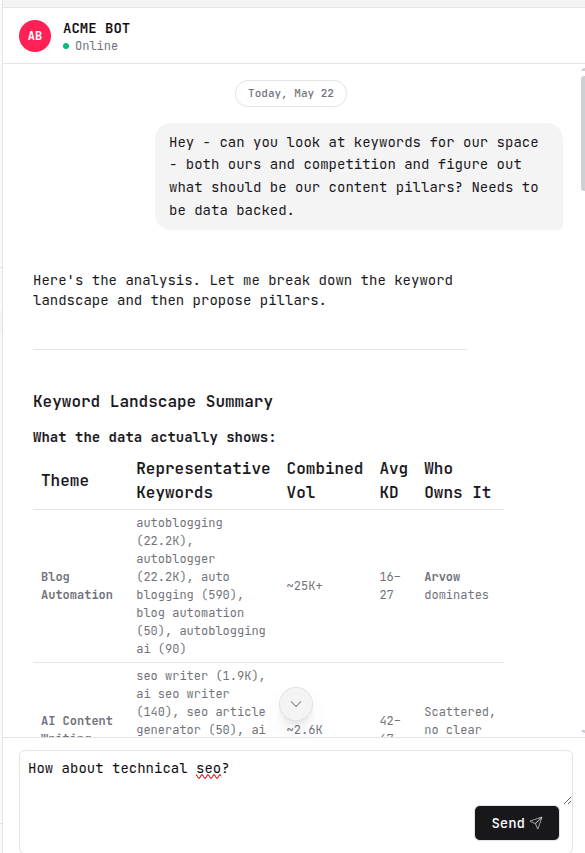
basically, ACME.BOT creates / edits the topic map based on live data of keyword volume + gaps with competitors. Edits come from the founder, but no writing is done yet.
Before posting anything, we initially built out the map in a Telegram thread. It looked at volumes, analyzed the landscape for who's already ranking for things, then suggested pillars. I flagged the ones I (really) had opinions about, cut three, and added two it had missed.
That hour shaped every step that followed. The agent had the data; I had the judgment about what we could credibly say.
A calendar I actually keep
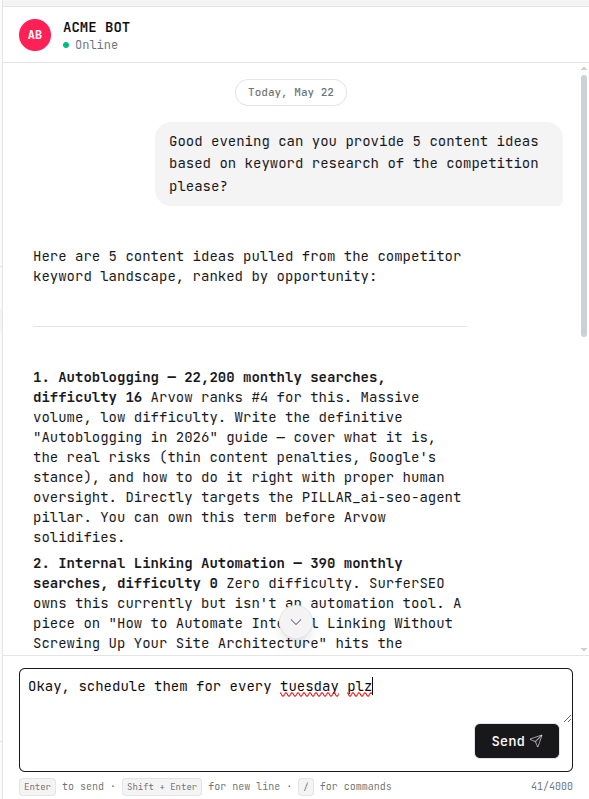
As opposed to posting to individual socials daily, the founder will calendar it out weekly. ACME.BOT can recommend that calendar based on the topic map.
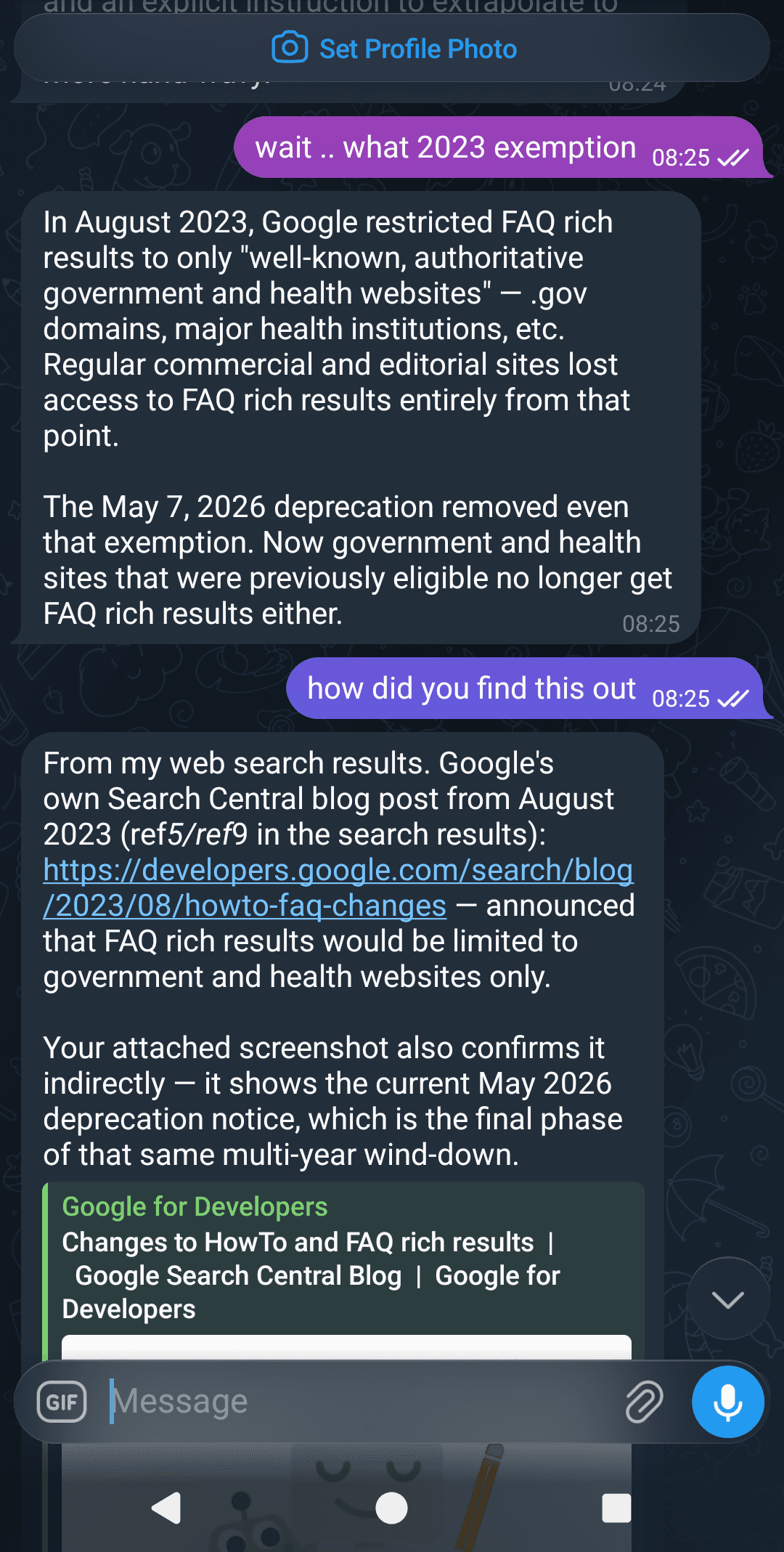
The agent told me to post everyday. I said no, because basically, they'd be pushing a firehose of content on me each day. I prefer to take things at my own pace. Right now, I can really manage one post a week and if I had to chose between churning out five posts that no one remembers or one good post a week, I'd chose the one good post a week.
Tuesdays are always our calendar day, so our agent drafts well ahead of time while I review them on my own time. Slow is fine, but slop is not.
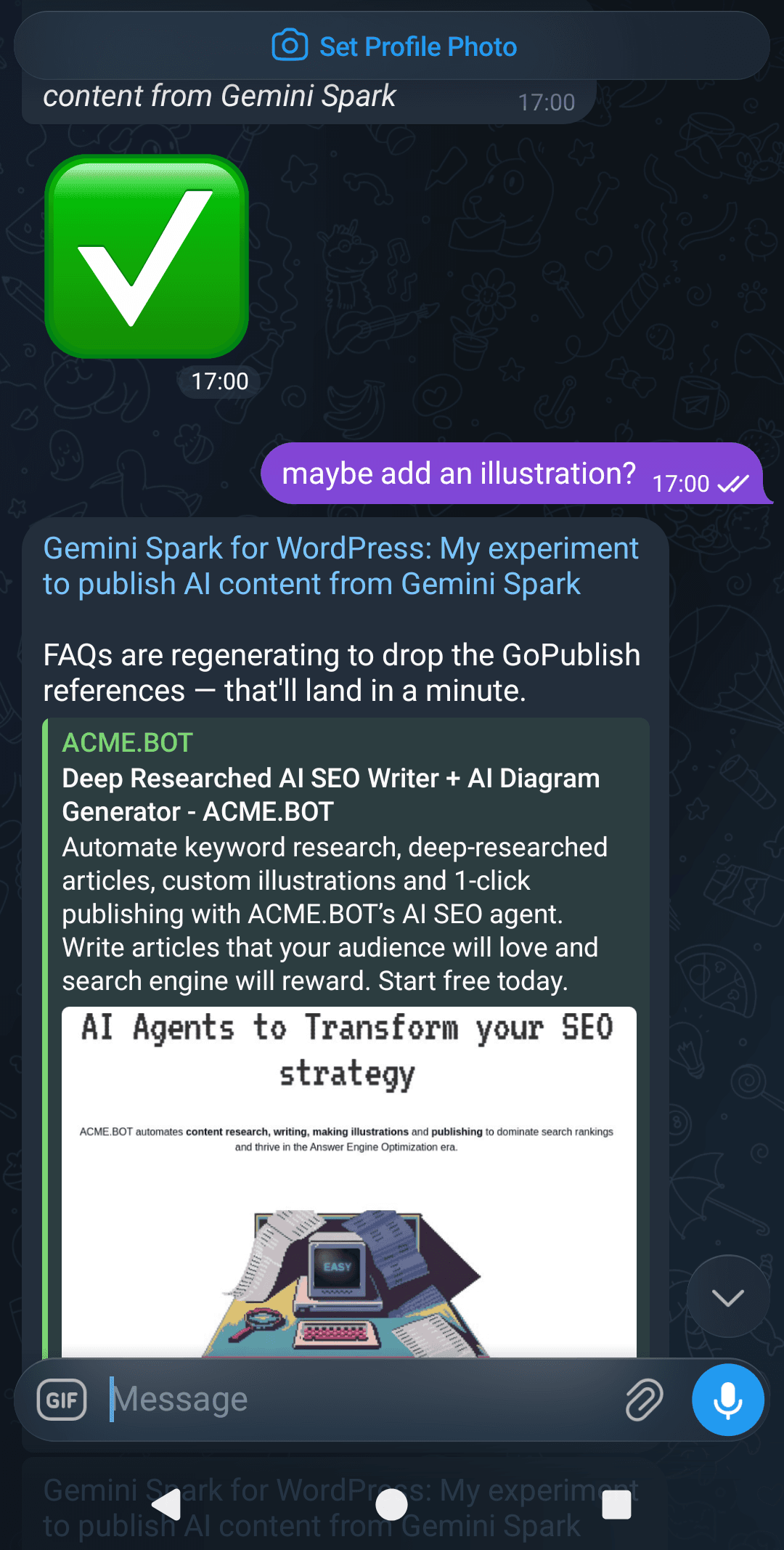
Nothing publishes unsupervised
ACME.BOT is a human in the loop process where the AI stops twice for founders to review and approve on Telegram, first the outline of the article and then a second time on the final article.
I have two gates on my phone. An outline gate, where I kill weak angles before they're even a draft. And a finished piece gate, where I read it back to make sure it says something that I would put my name on.
I tend to impose my own views vs simply rolling with the defaults. My thoughts and opinions on SEO / AEO may not always align with the average views - especially given this is a field filled with many dubious claims and opinions on the internet.
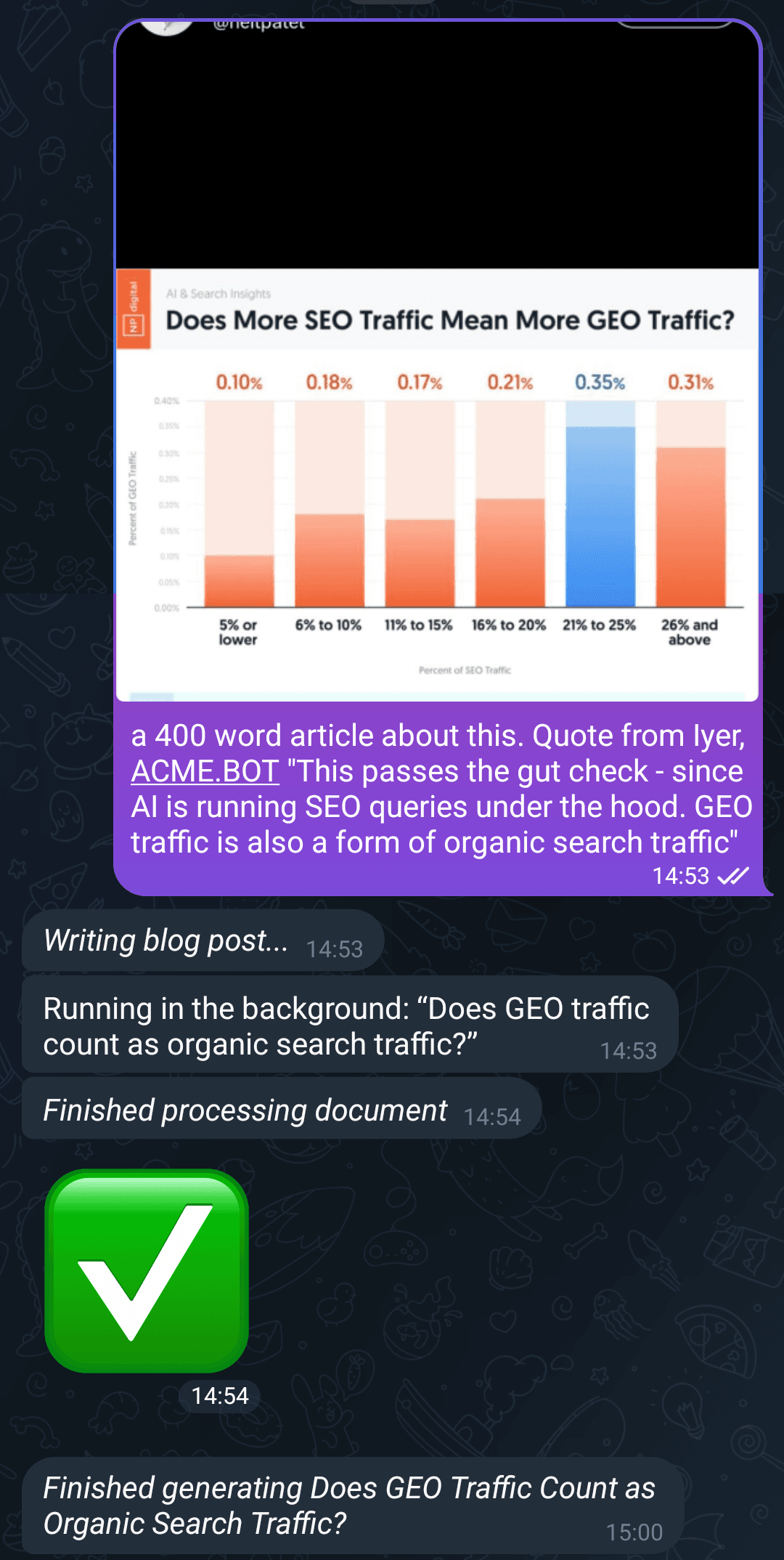
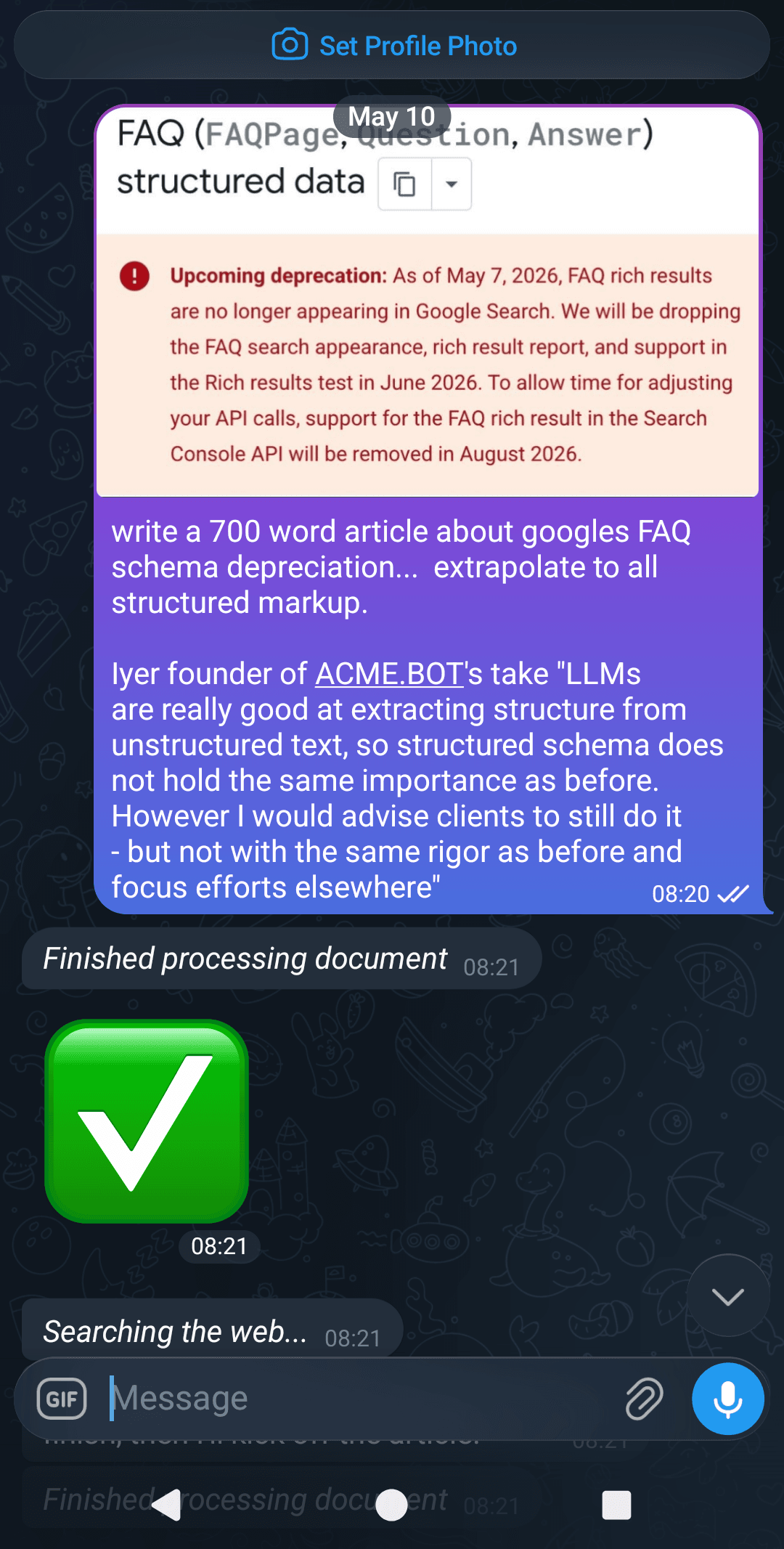
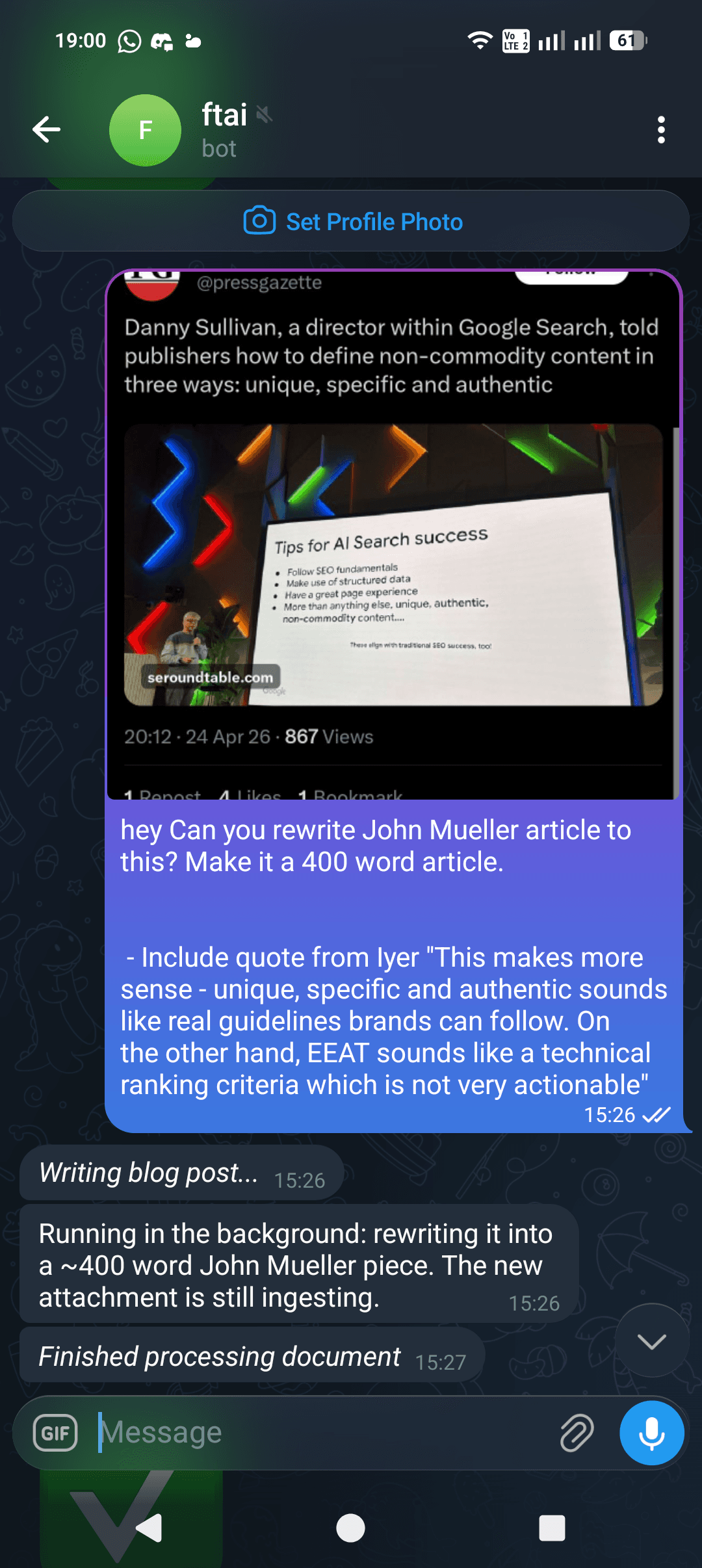
When X hands me a take
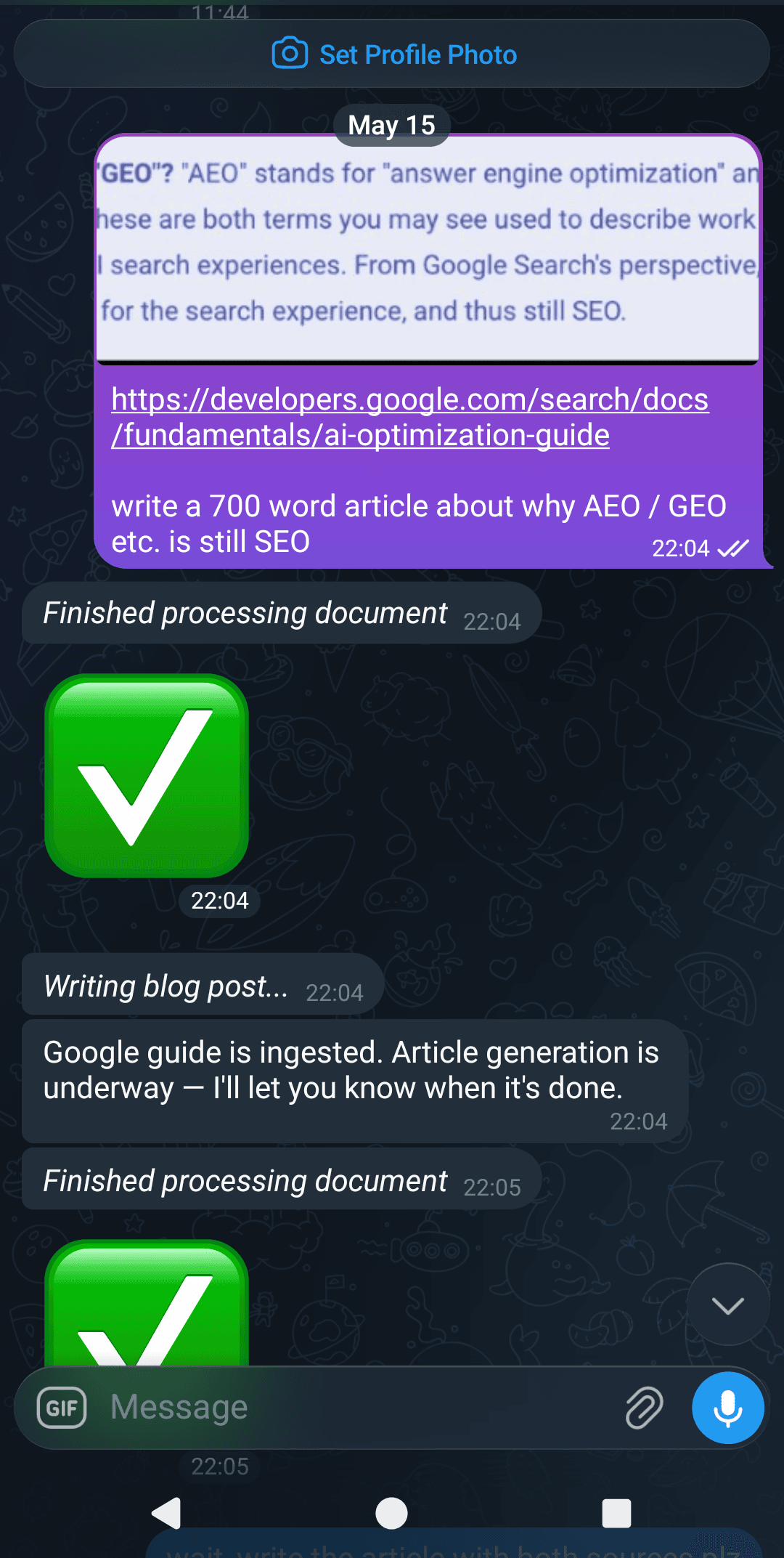
If the founder comes across something intriguing on X, he will send it to ACME.BOT on Telegram with his take on it. The bot will then create a post around that take.
Half my best posts start on X. Someone insists AI content can't rank; I disagree, capture it, and write back to the agent: "Post about this. My angle: it ranks if a human owns the judgment."
Why does this feel like a draft in my own voice, citing the thread? I'm not prompting a chatbot here -- it feels like I'm giving my opinion to something that already knows how I write.
Why this isn't slop
ACME.BOT posts won't be a generic ai summary but will be opinionated with a specific perspective. Each draft can be reviewed by a named operator to set the tone of the articles.
Generic AI draft
unsupervised- Reads like it fits any company
- Summarizes; never takes a side
- No first-hand experience
- Cites nothing, or cites itself
After my review
human-in-the-loop- Built around an angle I chose
- Makes a claim and backs it
- Carries my opinion and edits
- Cites real sources I checked
- My fingerprints are on it. Sure, the agent will do the labor, but I still have to do all of the thinking. The angles. The strategy. The line edits -- are all mine.
- It's specific, not summarized. Typically a post will start with a claim then an explanation or support for that claim. Please do not send in posts that can be about any company and not ours.
It's dull and absolute. Would I actually want to read this? If no, don't put it out there.
How this clears Google's bar
Google tends to reward content that is clearly E-E-A-T Quality, is people-first, and isn't commodity. It's worth noting that this type of content cannot just be AI-generated and then, end of the process, have a people-first or E-E-A-T lens retro-fitted to it. Instead, the context of the workflow has to revolve around it. This is precisely what the unofficial review loop above results in.
You couldn't just "turn on" E-E-A-T at Google. It was a signal that ranking tried to infer: was there an actual person behind this? Did they understand the subject matter? Would a searcher trust that person as an expert on it? You can't cheaply fake that signal, and each year systems get better at catching folks trying to do so.
I'm not putting together a list that I'll apply to a finished draft. My workflow above -- the angle I pick, the named author, the outline I kill, the sources I check, the draft I edit -- shows that I'm creating content's E-E-A-T as I write, rather than applying it later.
What Google actually says it wants
Google's public guidance has gotten blunt. In May 2025, John Mueller told creators to "focus on making unique, non-commodity content that visitors from Search and your own readers will find helpful and satisfying." Commodity content -- factually correct text that carries no unique data, no first-hand experience, and no point of view -- is now exactly what Google filters out. It competes with what a model can spit out in seconds, AI Overviews summarize it before anyone clicks, and it earns nothing.
The official framing is "helpful, reliable, people-first content," and Google hands you a self-test for it: Who made this, How was it made, and Why does it exist? Content made by an identifiable person, with hands-on involvement, to help readers -- rather than to rank -- is what the systems are built to reward. None of that prohibits AI; Google's own policy says so. What it prohibits is content made to game search instead of to serve a reader, regardless of whether a human or a model typed it.
Quick answer
AI-generated content can rank on Google when it's factually accurate, genuinely helpful, and reviewed by a named expert with accountability for it. Importantly, Google's algorithms are designed to assess the resulting level of effort in a piece of content, not the specific model or tool used to create it.
E-E-A-T, one letter at a time -- and where ours comes from
When Google's human raters apply Google's 181-page Search Quality Rater Guidelines (updated September 2025) to content, they rigorously consider its Experience, Expertise, Authoritativeness, and Trustworthiness, aka E-E-A-T. E-E-A-T is what those raters ultimately factor into whether or not they trust a piece of content -- with trustability lying at the core of it all. That said, where does E-E-A-T come from on this blog, and why is it not all for show?
- Experience (the first E, added in 2022). First-hand in real-time. I post this blog, directly on Telegram. The screenshots above are from real threads, not some sort of mockup. If you've run an AI SEO agent, you'll know what to write about running an AI SEO agent -- and you can't fake that experience in a generated blog draft.
- Expertise. Written by (named, qualified author) with deep expertise. Prior to founding ACME.BOT, I built ranking systems at Google. Each post on this site is my byline, linked, and I take accountability for each -- not Admins or a fictional character.
- Authoritativeness. Reference real sources while sharing some opinionated, specific blog posts on a niche topic over time, and you'll be perceived as an authority on that topic in the eyes of your audience, who will then look towards you as the knowledge source on the topic. This is why we choose to publish weekly, not daily: it's the body of work, not the post count, that builds our authority.
- Trustworthiness. At the heart of E-E-A-T is accuracy, where a real human -- me -- is fact-checking each claim on credible sources, verifying it, and giving a transparent take. I wouldn't publish anything I wouldn't be willing to admit I wrote myself.
Why E-E-A-T can't be slapped on as an afterthought
This is where many teams go wrong. They generate a draft, then try to "add E-E-A-T" afterwards -- add an author box, drop in a couple of citations, sprinkle in "in my experience." Raters and ranking systems are specifically tuned to catch that. They don't want that decoration signal. They want whether content really could only be written by someone with the experience and judgment it claims.
Experience can't be retrofitted -- either the writer has run the thing or they haven't, and it shows in the specifics that a summary never has. A point of view can't just be appended at the end -- it has to shape which angle the piece takes, what it leaves out, and where it disagrees with the consensus. Trust isn't a badge in the footer -- it's accuracy that was verified before publish by someone accountable. The moment you treat E-E-A-T as a post-processing step, you've already produced commodity content; the best you can then do is disguise it, and that disguise is exactly what the system hunts for.
That's why the order matters here. The angle comes first -- I choose it. The outline gets a human gate -- I kill the weak ones. The draft gets a second gate -- I edit and approve. The author is real and named throughout. The content is built around the E-E-A-T; the E-E-A-T is never applied to finished content.
Commodity vs non-commodity, in practice
Commodity content
filtered out- Factually correct, but says nothing new
- No first-hand experience behind it
- Author box bolted on after drafting
- Summarized by AI Overviews; earns no click
Non-commodity content
what we publish- Original angle, data, or judgment in every post
- Written by someone who runs the thing
- Named, accountable author from the first line
- Worth the click even after an AI summary
The spam policies this avoids by design
Google's March 2025 spam update expanded what counts as abuse to include scaled content abuse: producing many pages primarily to manipulate rankings, whether by humans, by automation, or by both. The quality rater guidelines now instruct raters to give the lowest possible rating to pages where all or almost all of the main content is auto- or AI-generated with little effort, originality, or added value -- explicitly "regardless of production method."
I have one post reviewed weekly with two stages of human gate, which is the alt to scaled content abuse. We don't do mass-production and the effort -- the judgment, the edits, the fact-checks -- is the point of the whole thing. Could we trip the "mass-produced, low-effort" wire? No. One reviewed post a week is a deliberate ceiling -- not a limitation I'm waiting to remove.
Information gain: the part most AI content misses
Underneath all of this is a quieter signal: information gain: how much a page adds beyond what's already on the web. It's the difference between rephrasing the consensus and contributing to it. An analysis of the December 2025 core update found that 92% of the sites that gained owned some proprietary asset -- original data, first-hand testing, a distinct viewpoint -- versus 57% of the sites that lost.
In general, if you train a model on public web right now, it is an averaging machine: you ask a question and it gives you the consensus -- which is a 0 information gain. The only information gain you get is if you put in something that wasn't already on the web: a take from running the blog, a screenshot of the actual workflow, a disagreement with the prevailing wisdom. It's that thing that is, by necessity, human. The agent is just what scales the labor of turning that thing into a finished, sourced, published post -- not what actually makes the gain, but what carries mine the last mile.
Trust isn't created at the very end. Either a real person with real experience shaped it before it existed, or it's just the average of the internet -- something Google can already serve up.
Before you ask
To answer the most frequently asked questions in one place.