
What Autoblogging Actually Means
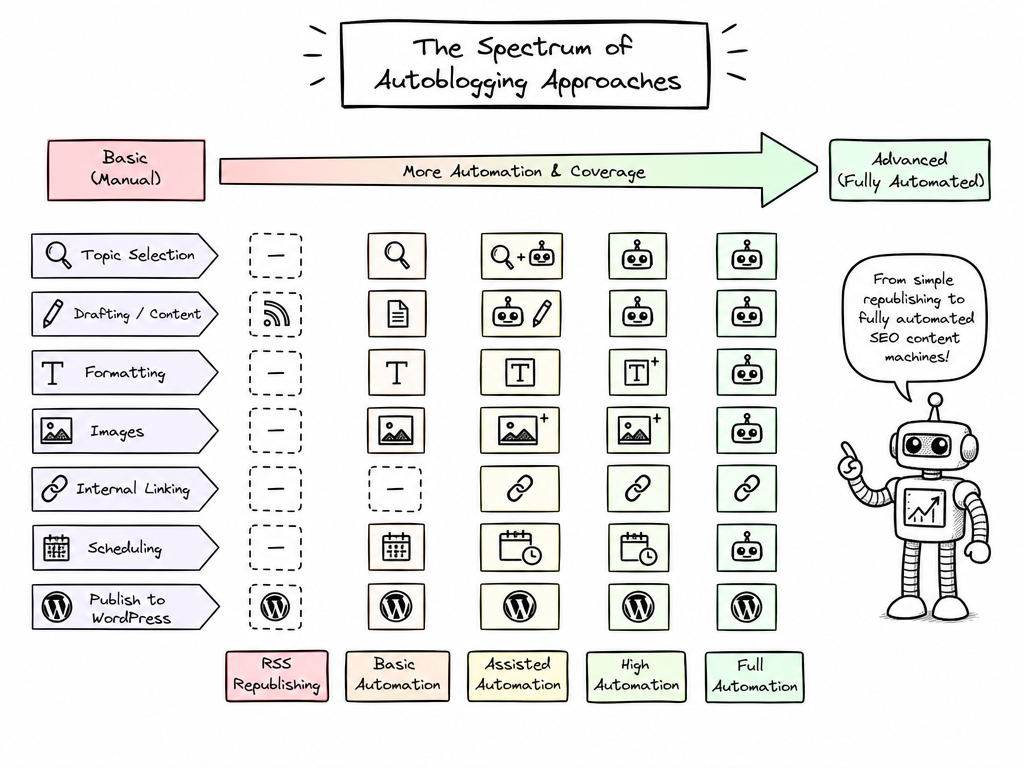
Autoblogging software automates your entire publishing process beyond just writing the actual blog posts by helping you with topic selection, content drafting, formatting, images, internal links, and scheduling them to WordPress. It encompasses a range from simple RSS republishing to fully AI-generated SEO articles. Its automation can typically take care of the entire plan, write, and publish process—most of which would otherwise need people in place at every step. It could solely republish feeds or utilize a more complex AI composition system that understands keywords, develops posts, and schedules them to post on your blog. It’s essentially a blend of blog automation, AI blogging, and content operations—which is why some small teams are now creating more content than an entire editorial team would have been able to do in the past. Why are people opting for it? The reasons are pretty simple.
People typically mix up autoblogging to just “AI writes one post.” It’s got a wider meaning. Some autoblogging tools work by republishing content from other sources, while others create original articles copy from scratch. Most of today’s modern autoblogging process are built on the end of that spectrum that involves AI-generated content, which is the level that actually makes scaling possible.
Why Autobloggers Are Drawn to It
Autoblogging is advantageous to teams because it enables consistent scaled publishing without hiring more writers to keep up, allows you to target many keyword queries at once under one site and — thanks to AI-powered automation tech handling the heavy lifting — has now become attainable to small teams.
Time and cost savings
Invest in just the system—not a whole team. Let the system do the work of drafting, scheduling, and formatting your newsletter, while you focus on the important reviewing pieces.
Topic and keyword coverage can get broader
Instead of chasing one query with a post, one site can chase many at once. In the same timeframe it takes to publish, say, 5 posts, an autoblogging setup can produce 10x the volume—improving organic reach without needing to scale headcount.
Automation is now within reach
Abhishek Iyer, founder of ACME.BOT, got started with hopes of automating blog writing—a pain point he was familiar with from being part of a team tasked with publishing a ton of content. AI SEO agents have since automated a lot of the technical plumbing. You don’t need an engineering team.
Of course, there is a tradeoff. That speed comes with risks that require a different kind of rigor to manage.
The Real Risks Every Autoblogger Must Know
Four major threats await Autoblogging without safeguards: Google’s March 2024 update removed an estimated 45% of low-quality AI content from its search results, scraped content can get you in copyright trouble, unedited AI content ranks 30-40% lower than unique content and AI hallucindations can introduce errors or misinformation. Fortunately, simple fixes exist for each — but ignoring them could easily tank your SEO and get you in legal hot water.
Rankings Collapsed Due to Thin Content
According to Flows, autoblogging sites with unedited content rank 30-40% lower than those with more unique content. Google has a scaled content abuse policy which targets content that is primarily created to manipulate rankings and provides little value to users.
If you receive a draft from AI that puts a good amount of content on the page, don’t fall into the trap of thinking it is finished. Instead, treat the output as an initial draft and rewrites the intro, add your own research to it, and add personal insights throughout. Putting an extra 20 minutes into editing the content is often the difference between pages that rank, and pages that don’t.
Google Removed 45% of Low-Quality AI Content
In March 2024, Google rolled out a new core update, writing it eliminated an estimated 45% of unoriginal, low-quality content found on Search, according to Tech Funding News. But without value, volume won’t be king.
Make sure every article you write shows original insight and genuine expertise. Use relevant citations, real data, or original research to support your claims and explain why your point of view matters. Pages that don’t add any value beyond what AI generated content would get purged.
Copyright Risk is Created by Scraping
According to the NYT v. OpenAI lawsuit, OpenAI reproduced near-verbatim amounts of scraped content word-for-word. And when third-party content is reposted, even if it’s lightly edited, the sender is accepting the legal responsibility of the person who created it.
Unless you’re rewriting or have permission to repurpose the content, consider using AI to generate an original draft instead.
AI Hallucinations Introduce Factual Errors
AI models may state false claims in a confident way. Hence, before publishing any draft, you should conduct human reviews to check claims at a granular level. When you do this, cross-check the facts in your content like dates, quotes, and statistics with primary sources.
The reason you’re likely to see increasingly frequent common failure modes is why use a hybrid approach that involves an AI-generated draft and human editing.
How to Do Autoblogging Right: The Hybrid Approach
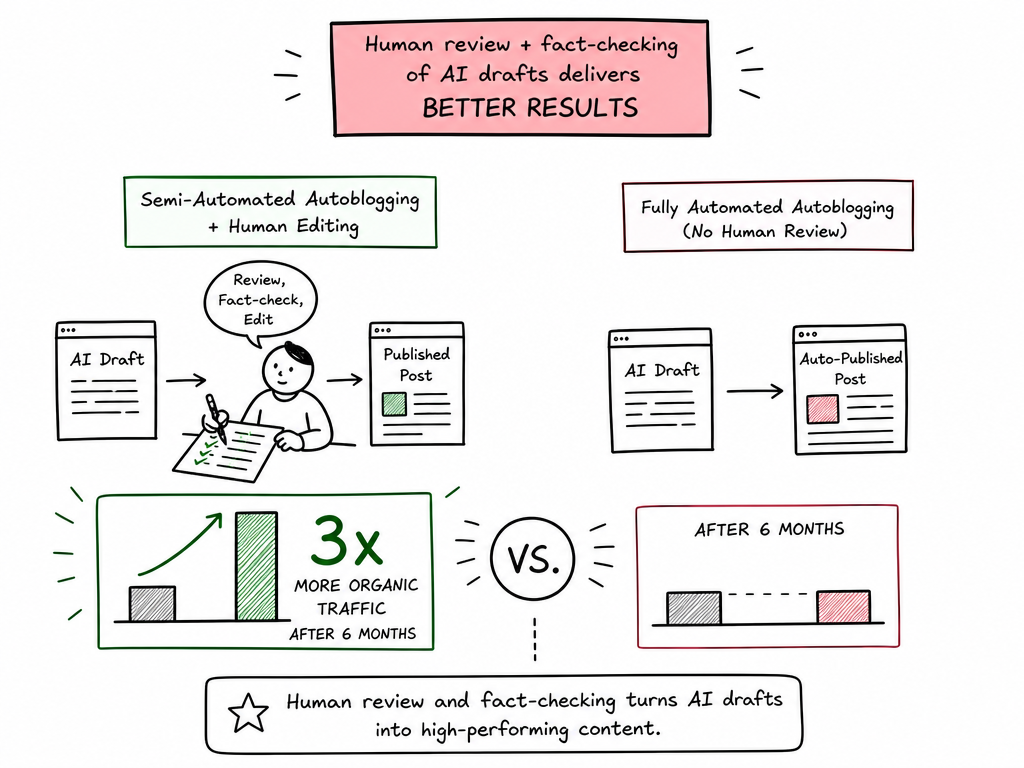
After 6 months, the semi-automated blog content – where AI drafts are edited by humans – receives roughly 3x more organic traffic than fully automated posts. You can get this done in as little as 20-40 minutes per post. Google states that AI-generated content is allowable as long as its created for users and not just rankings. Additionally, 9% of pages that rank in the top 10 search results are 80% or more AI-generated. Still, it’s important to always treat this content as a first draft: first publish it to a WordPress draft, check for plagiarism, and fact-check claims using primary sources.
“Every draft lands in WordPress as a draft. A person approves it, or it never goes live.” — Four Eyes, 500-article case study
1. Your 20-minute edit is the difference
You’re checking tone, adding examples only you know, and verifying facts hit. That’s what separates ranked content from noise.
2. Plagiarism check, then fact-verify
Do a quick plagiarism scan. Then find and manually verify the source for any difficult-to-check claims, like these. Five minutes that protect your credibility.
3. WordPress draft gate as default
Before we post anything, it’s always sitting in draft waiting for someone’s okay. At ACME.BOT, that’s the default, not the backup plan.
4. Layer in interview-based blogging
Start with an AI draft. Then ask experts the questions you can’t find answers to online. Finish with a synthesis. It’s hard to scale and fake.
Making Autoblogging Work Long-Term
View AI as your operations layer, not your content publisher. Treat it like that, and ensure every piece goes through a human gate before it’s published. When it comes to trust (and then SEO), human reviews will be a requirement: In fact, Deloitte found that 68% of consumers are concerned that synthetic content might be used to deceive them. The scaling model that works (and how many mature content operations automations are structured) is pairing AI research and draft creation with human voice and verification reviews. To get there faster, audit your current workflow for steps that don’t include human review.
Humans are always responsible for the work we publish.
— Harvard Business Review
The difference shows up in whether readers come back—and whether Google keeps sending them. When you treat AI as a drafting tool rather than a publisher, you’re not slowing down. You’re building the structure that actually scales.
Action: Map your workflow now. Which steps have no human sign-off? That’s your first lever.