Why Disconnected Articles Stall Your SEO Content Strategy
An SEO content strategy determines what you publish, the audience that you publish it for, and what that content should acheive for your business. Content posts stop moving if nothing is making those decisions. Start by choosing a goal – a goal could be signups, sales, or leads. Then, choose a reader that your content will be for – they could be an agency, a Shopify store owner, or a SaaS marketer.
Here’s how most stalled blogs look:
- No one’s ever researched topics buyers search for.
- No one’s ever identified the audience for each post.
- No one’s ever matched a post to a goal someone’s tracking.
- Nothing connects the post back to the rest of the site.
“I think people often have adhoc or no strategy at all.” — Abhishek Iyer, founder of ACME.BOT
That’s often the disconnect. E.g., a Shopify store wants signups, not sales. Fabric guide and product comparison might be related, but they’re for two different readers and have two different functions.
Once you know the reader and goal, you then ask what they might actually type into search.
Map Audience and Search Intent Before Picking Keywords
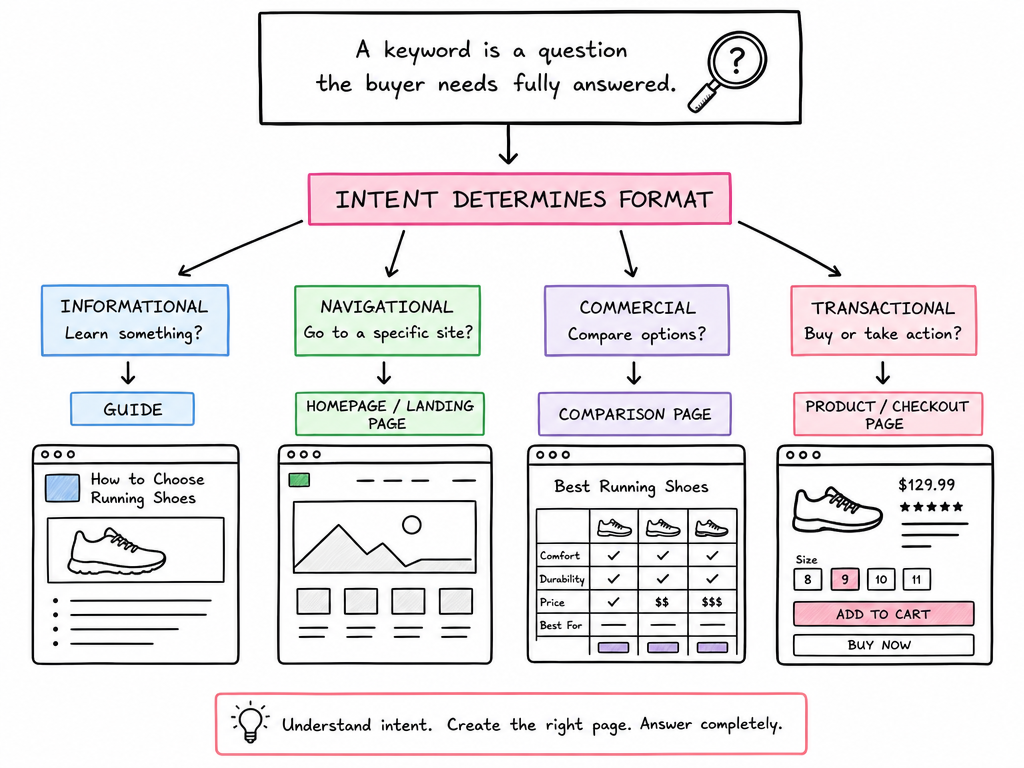
Start with your audience, not the keyword list. While you might be tempted to put a list of keywords in a page title, buyers may end up using completely different words than you expect. For that reason, you should figure out the core reason behind each query, sort them into four different “intent” buckets, and assign each bucket to a different type of content (or page).
| Intent | Example query |
|---|---|
| Informational | “how to do keyword research” |
| Navigational | “Shopify admin login” |
| Commercial | “best project management software” |
| Transactional | “buy running shoes” |
Different types of content fit different types of visitors. For instance, buyers ready to act fit product and checkout pages; shoppers weighing options fit a comparison; and learners fit guides.
A keyword is a question the buyer needs fully answered.
“I think people often think they understand the customer and structure content around it.” — Abhishek Iyer, founder of ACME.BOT
The gap often comes down to wording. For instance, your “task board” could actually be their “project tracker.”
“However, it’s often the case the customer has something else in mind – a slightly different pain point, a different need or just a slightly different vocabulary than what we expect.” — Abhishek Iyer, founder of ACME.BOT
Once you pick up their vocabulary, topics can practically write themselves.
Pillars give the overview, so score every topic against real search data
While the clusters answer narrow questions, the pillars give the overview. Then, rate each topic from 1 to 5 on difficulty, business value, and intent fit. Then back it up with real search queries. For agencies, each client should start with one pillar.
- Pick the hub. Pillars establish the base. Clusters each answer one question and link back.
- Score every topic. Rate intent fit, business value, and difficulty from 1 to 5, with 5 meaning easiest to win.
- Cross-check against search query. Guesses may deviate. If you come across a search query that differs from your guess/spreadsheet, the search query is likely more accurate.
“Grounding in real search data and iterating is the core of a good SEO strategy” — Abhishek Iyer, founder of ACME.BOT
- Check the proof.
- Tripledart’s Phyllo pillar-cluster model increased blog traffic by 573% – from 1.5K visitors to 11K.
- Within 6 months, SoniNow’s pillar pages generated 28% of the organic traffic to their site.
“Data makes this bare.” — Abhishek Iyer, founder of ACME.BOT
- Scope agencies. Pick a pillar per client and then expand into clusters.
After all, these links that connect are in need of a good plan.

Link Your Clusters, Pace the Calendar, Split Shopify From SaaS
Every cluster is connected by its pillar through internal links. Create connections between your pillar and its supporting pages along with their adjoining pages
Screaming Frog compiled data from hundreds of controlled tests: 80% of internal linking changes were positive, averaging a 173% click gain.
There is an order to this. First, do your pillar content, second your clusters and finally, only add one refresh slot each cycle. Most teams skip that slot.
| Shopify | SaaS | |
|---|---|---|
| Main move | Refresh collection intros and links | Build comparison and use-case clusters |
| Where links point | Collection pages | Signup and demo pages |
| Proof point | Eyeful Media reported +84% sessions and +32% revenue over 90 days, after a collection-intro and FAQ project | Not measured here; test it yourself |
Next up? Ownership – aka, where AI really can pay its way.
Let AI Execute, Not Decide
AI tools left alone drift off topic, so set the pillars yourself. – But keep in mind that Google’s scaled content abuse policy can flag bulk pages. To avoid this, fact-check every draft. Generic copy loses to first-party evidence.
When topic choices are made by tools, we’ve seen topic drift at ACME.BOT.
Bulk is cheap. Trust isn’t. Google’s spam policy takes aim at piles of pages built to game rankings, and generative models predict likely words rather than retrieve facts.
Alternatively, maintain a log of tests with dates:
Page, change, clicks a week before and after.
If you retitle a content pillar on March 3 your then-logs become evidence your next can’t just make up.
Don’t obsess about a schema. Rank first and write self-contained sections.
“Reality is that AI is extremely good at extracting structure and doesn’t necessarily prioritize the pages that markup”
— Abhishek Iyer, founder of ACME.BOT
Pair Intent Buckets With Conversions, Then Fix the Four Usual Stalls
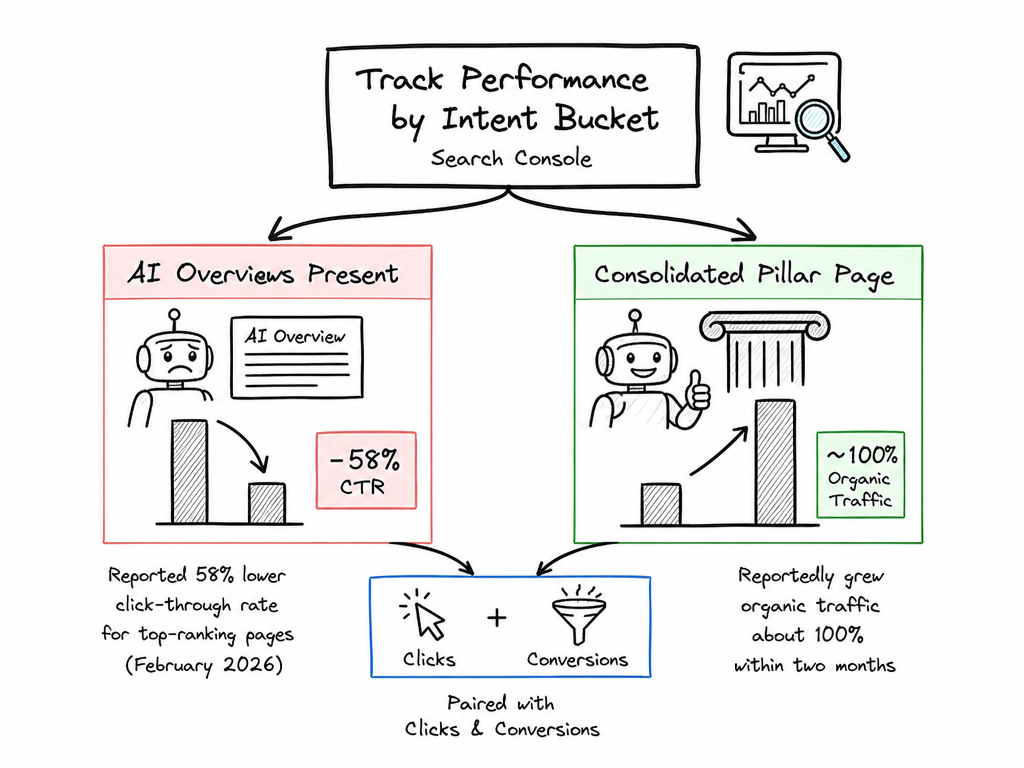
Clicks to Conversions Per Intent Group. AI Overviews seem to have lower CTRs and a consolidated pillar can quickly increase the volume of topic traffic. Four failure modes stall most plans, and AEO and GEO still require SEO.
Clicks mean little on their own. Match each bucket with conversions.
Ahrefs found that the presence of an AI Overview correlates with a 58% lower average clickthrough rate for the top-ranking page.
That’s a big drop. You could be #1 and still lose several clicks.
InBound Blogging says the opposite too and claims that, by combining their pages so that they had just one pillar page, in just 2 months their organic traffic grew about 100%.
“The real power of SEO / AEO is 1. content compounds and 2. captures intent at various stages” — Abhishek Iyer, founder of ACME.BOT
Four behaviors that derail most plans:
- Writing without intent checks
- Writing topics that are off-pillar and dilute clusters
- Publishing orphan pages with no internal links
- Publishing AI drafts without human reviews
Don’t hunt for llms.txt when Google is saying AI Overviews are not special files.
Prioritize doing this check and one pillar audit this week:
- Every target keyword is intent mapped
- Each pillar set (topic) has a defined scope
- Pillar and cluster pages link to each other
- Human reviews all drafts
- Metrics are tracked by intent bucket