Why I Wanted to Try This
I’m always looking for better blog automation, and I found Meta Muse interesting as it was designed to do things (book travel, send emails, fill forms) — not just write text. When it became clear that Muse Spark 1.3 had gains that showed a real step jump in the Spark series benchmarks, I had to take a closer look.
- Muse as a task agent. Unlike most LLMs for text generation, Meta highlights Muse’s capabilities for actual task executions.
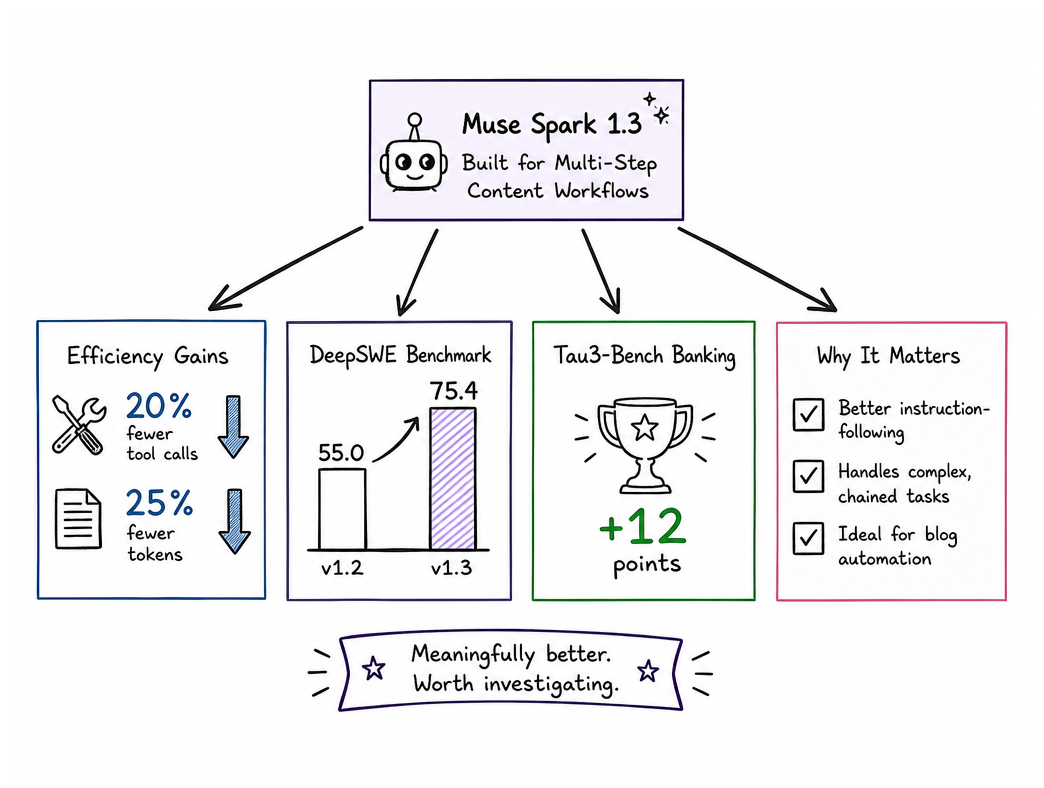
- Benchmark gains that matter. According to Artificial Analysis, Muse Spark 1.3 showed a 12-point gain in Tau3-Bench Banking (35% to 47%) and a 5-point gain in Terminal-Bench 2.1 (80% to 85%).
- The real test. Whether a general-purpose task agent can carry a content workflow end-to-end.
“Muse has shown huge promise. muse spark 1.3 has been great on the benchmarks (step jump for muse spark series) and im eager to try it out myself”
— Abhishek Iyer, founder of ACME.BOT
Between ideation and publication, many tools require us to do a lot of manual legwork — which Muse aims to reduce.
What Muse Actually Is (And What It Isn’t)
Muse is Meta’s own AI agent. Powered by the Muse Spark model family from Meta Superintelligence Labs, it’s a natively multimodal, reasoning-first system that can execute real tasks instead of just generating text. Muse 1.3 is more efficient than 1.2, making 20% fewer calls to external tools and using 25% fewer tokens. But here’s the thing — Muse is a task-execution agent, not a blogging tool, and that tension is exactly what this experiment tests.
Muse does more than just suggest completing the writing: it manages your emails, sets up meetings and travel, fills out forms, pays for online shopping, connects to other services, and executes the work you would normally do yourself in the browser.
The reasoning-first architecture is important here. When Meta announced Muse Spark 1.3 benchmarks, we saw some notable jumps: DeepSWE increased from 55.0 to 75.4, and Tau3-Bench Banking jumped 12 points. These both represent meaningful improvements in the model’s ability to follow instructions for chains of complex or compounding tasks–where one small, lowuria error builds on another.
According to Meta AI Research, on multi-step tasks, Muse Spark 1.3 doesn’t drift from the requested workflow, drop constraints, and preserves detailed requirements.
Lower token count means reduced cost per task. Fewer tool calls mean faster execution. You can see the benefits quickly add up when you apply that to dozens of blog posts.
While Muse can definitely generate text — the real question is whether an email and travel-bookings general-purpose task agent will learn to tackle content workflows. We’re about to find out — at least when we hit the WordPress integration layer.
The WordPress Gap: What I Found When I Actually Looked
I haven’t run a live workflow test yet—still in setup, Muse is U.S.-only at launch, a third-party SEO tool with the same name will clutter your search results and send you nowhere, and Meta’s Muse has no official WordPress integration. That’s the constraint stack you’re working with.
No official WordPress integration exists. Daily services like email, calendars, and Instagram are listed on Meta’s documentation about Muse. However, there is no mention of WordPress. I checked the sources no luck.
There’s a confusing third-party tool. When you Google for “Meta Muse WordPress”, you might also stumble upon a Muse SEO tool with WordPress integration claims. This is not Meta’s Meta Muse tool and you’ll lose time comparing the two. Avoid it.
Access is only available in the US, and will be priced at $20–$100/month. If you are outside of the US, you won’t be able to access this tool. If you are in the the US, expect to have paid tiers in addition to the free tier. Important thing to point out that could be a reason not to invest too much time in designing a workflow around this tool.
Haven’t done a live test yet – still getting the right setup. But after these three findings, the experiment has come down to a solid question: can Muse patch into WordPress at all, or is the added friction too much given other tools with this use (migration or the like) in mind from the get-go.
How Other AI Tools Already Connect to WordPress
Byword, Writesonic, n8n, and ACME.BOT handle the WordPress handoff out of the box, including post status, tags, cover images, one-click publishing, and full REST API automation. Muse has none of that. If you want to use it for blog automation, you’re building the bridge yourself.
| Tool | Integration | What It Does |
|---|---|---|
| Writesonic | Dedicated plugin | Enables direct publishing to WordPress.org, allowing you to set post status, tags, author, and cover images |
| Byword | Native plugin + REST API | Lets you publish AI-generated drafts in a live post or as a draft with a single click of a button, preserving post metadata and formatting |
| n8n | WordPress node | Facilitates a connection between any AI model output and the WordPress REST API, enabling posts to be published with automation |
| ACME.BOT | Native WordPress connector | Publishes AI-generated posts directly to WordPress with full metadata, scheduling, and one-click workflow — built for this exact use case |
The gap couldn’t be any wider. Muse requires you to build it, whereas all of these tools come built into WordPress, so you’re not spending time setting things up or looking for a workaround.
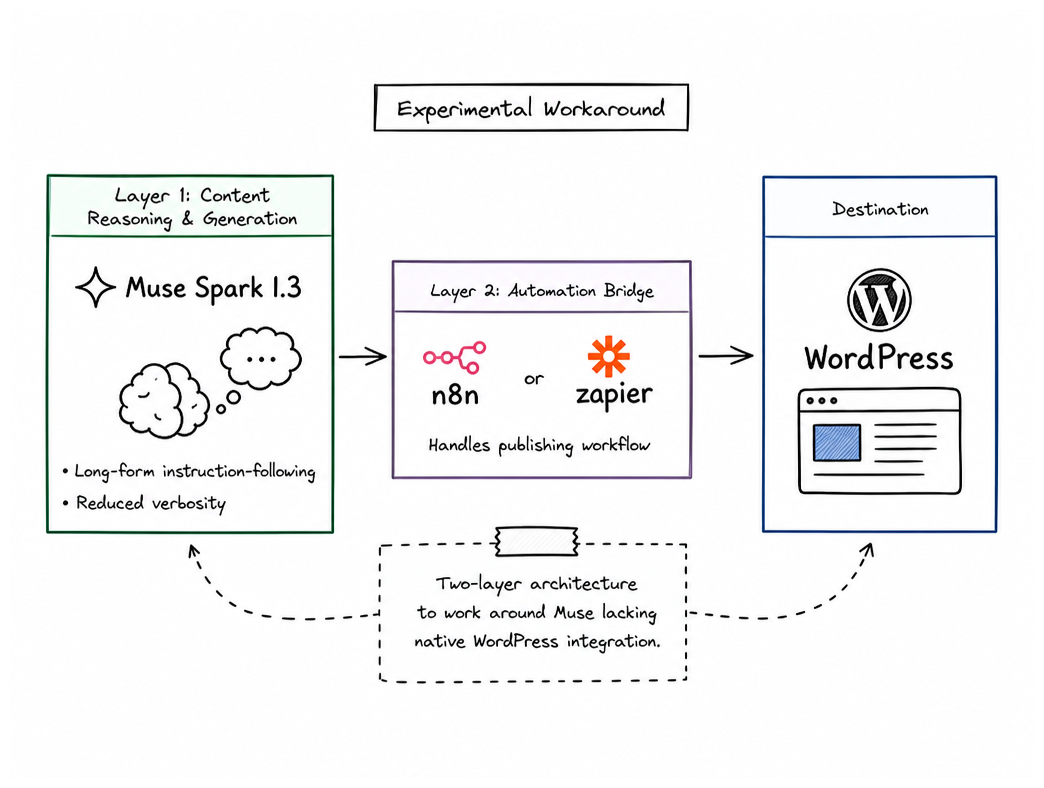
Where the Experiment Stands — and What I’m Building Toward
Muse hasn’t started running the blog yet, but the research phase confirmed the potential. Muse Spark 1.3 can follow complex, multi-step instructions better than previous versions. It also cuts back on verbosity, which makes it a viable reasoning layer for content creation workflows. This tool is the type that ACME.BOT is watching closely, since its mission is blog automation and any agent that improves the pipeline is worth a true test. Next, we’ll have Muse act as the content reasoning layer with a separate automation bridge running the WordPress publish step natively – either n8n or Zapier can handle this. What this experiment will test, at the end of the day, is whether AI-driven content actually helps or if pipeline complexity counters its benefits, which is the real question.